
Displaying 161-170 of 735 results
Data Collection Reference Framework Task I II and III, WECAFC, 2018
To date no abstract has been uploaded for this document


 Report issue
Data Collection Reference Framework Task IV and V, WECAFC, 2018
To date no abstract has been uploaded for this document
Report issue
Data Collection Reference Framework Task VI Socio Economics
To date no abstract has been uploaded for this document
Report issue
De Residuo a Recurso: Cambiando paradigmas para intervenciones más inteligentes para la gestión de aguas residuales en América latina y el Caribe
El crecimiento poblacional y económico han impulsado un rápido incremento en la demanda de recursos hídricos, y ya el 36 por ciento de la población mundial vive en regiones con escasez de agua. En particular, la rápida urbanización, especialmente en países de renta baja a media, ha creado varios desafíos relacionados con el agua. Estos incluyen: una degradación en la calidad del agua, un suministro inadecuado y falta de infraestructura de saneamiento, particularmente en asentamientos periurbanos e informales crecientes.Este informe resume el trabajo de la Iniciativa del Banco Mundial: “Aguas residuales: de residuo a recurso” lanzada en 2018 para crear conciencia entre los tomadores de decisiones sobre el potencial de las aguas residuales como recurso. El informe resume los hallazgos y conclusiones de seis documentos técnicos y de un análisis profundo de varios estudios de caso. Los estudios de caso ilustran las mejores prácticas internacionales, y proporcionan ejemplos de proyectos y programas que promueven la aplicación de uno o varios principios de la economía circular.
Report issue
Declaración Conjunta de los Miembros y la Secretaría del MIC CLME+ Marzo 2020
Del 18 al 20 de marzo de 2020, se reunieron por 7ª vez las Organizaciones miembro y la Secretaría del Mecanismo Interino de Coordinación (MIC) CLME+ para la Gobernanza oceánica integrada en el Gran Caribe. Reuniendo a 10 Organizaciones Intergubernamentales con un mandato relacionado con los océanos, la reunión discutió, entre otros asuntos: a) la creación de un mecanismo permanente encargada de apoyar a la región en su afán de lograr un desarrollo sostenible a partir de las riquezas marinas del Gran Caribe; b) un Plan de Trabajo conjunto para el 2020; c) el desarrollo continuado de la plataforma digital "Hub CLME+", como plataforma común para la Gestión colaborativa del Conocimiento, apoyando así la acción positiva en el Gran Caribe en pro de los océanos.
6
Report issue
Declining Trend on the Mesoamerican Reef System Marine Protected Areas
The Mesoamerican Barrier Reef System (MBRS) comprises coral reefs in Mexico, Belize, Guatemala and Honduras. The Synoptic Monitoring Program (SMP) was developed to assess the coral reefs and associated ecosystems. This program is currently applied in most of the MPAs in the region. It includes sites selected within MPAs that represent strategic sites (Take and No take sites) for park managers on the back reef, shallow (5-12m) and deep fore reef (14-20 m).
2
Report issue
Developing Organizational Capacity for Ecosystem Stewardship and Livelihoods in Caribbean Small-Scale Fisheries (StewardFish) Project Document
StewardFish Project is focused on empowering fisherfolk throughout fisheries value chains to engage in resource management, decision- making processes and sustainable livelihoods, with strengthened institutional support at all levels in the Caribbean and North Brazil Shelf Large Marine Ecosystem (CLME+) region. The project is guided by the principles of an ecosystem approach to fisheries (EAF) and seeks to promote women’s empowerment through leadership and the importance of social protection for sustainable livelihoods.
1
Report issue
Development of a Sustainable Fisheries Fund for the Western Central Atlantic
This brochure is intended to provide guidance and proposed next steps for the development of a Sustainable Fisheries Fund (SFF) for the Western Central Atlantic Fishery Commission (WECAFC). The WECAFC member countries and FAO are currently working on the establishment of a regional fisheries management organization (RFMO) in the Western Central Atlantic region.
1
Report issue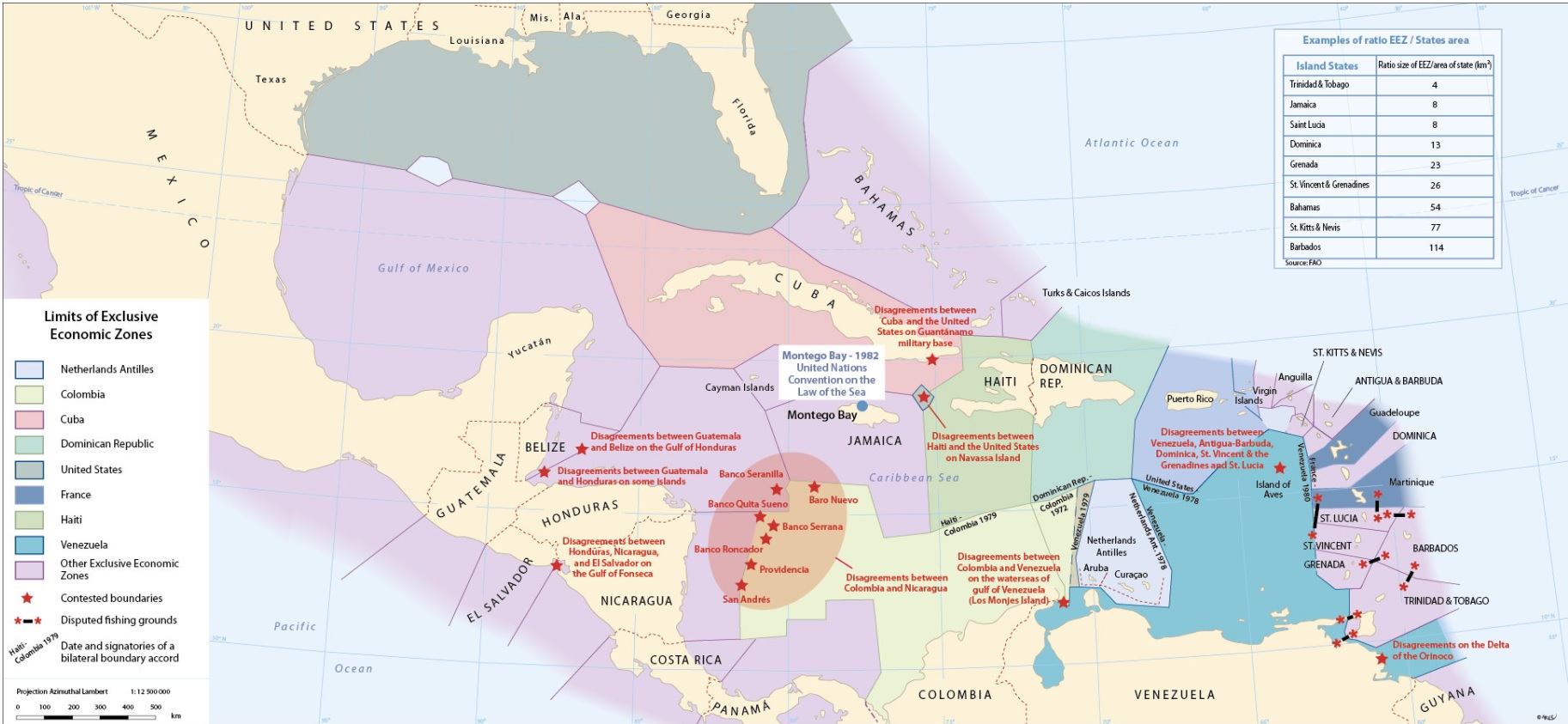
Dividing up the sea
Covering some 4 300 000 km², the Caribbean Sea and the Gulf of Mexico dominate their surrounding but frail continental or island perimeter arc. From the pre-Columbian era to modern times and through to the present, it is the multiplication and juxtaposition of zonal entities that have prevailed. Notwithstanding their vast surface dimensions, this maritime space is today entirely divided between bordering states. These invisible yet real boundaries which cut up this liquid expanse afford the region an image as complex as, but very different from, the classic political map. The smallest island can suddenly take on an unsuspected dimension, the ambitions of certain regional powers reveal themselves, and the stakes in play change in both nature and scale.
3
Report issue
Does International Marine Environment Law Work? An Examination of the Cartagena Convention for The Wider Caribbean Region.
This study examines the effectiveness of international marine environment law in controlling and abating contamination of the marine environment in the Wider Caribbean Region. The main international agreement covering the region is the Cartagena Convention which came into force in 1983. This convention, initiated by the UNEP under its Regional Seas Program, is considered one of the most successful of the programs. The study examines that claim in light of events since the adoption of the Cartagena Convention by the majority of nations bordering on the region.
Report issue