
Displaying 681-690 of 735 results
ToR Recreational Fisheries
To date no abstract has been uploaded for this document


 Report issue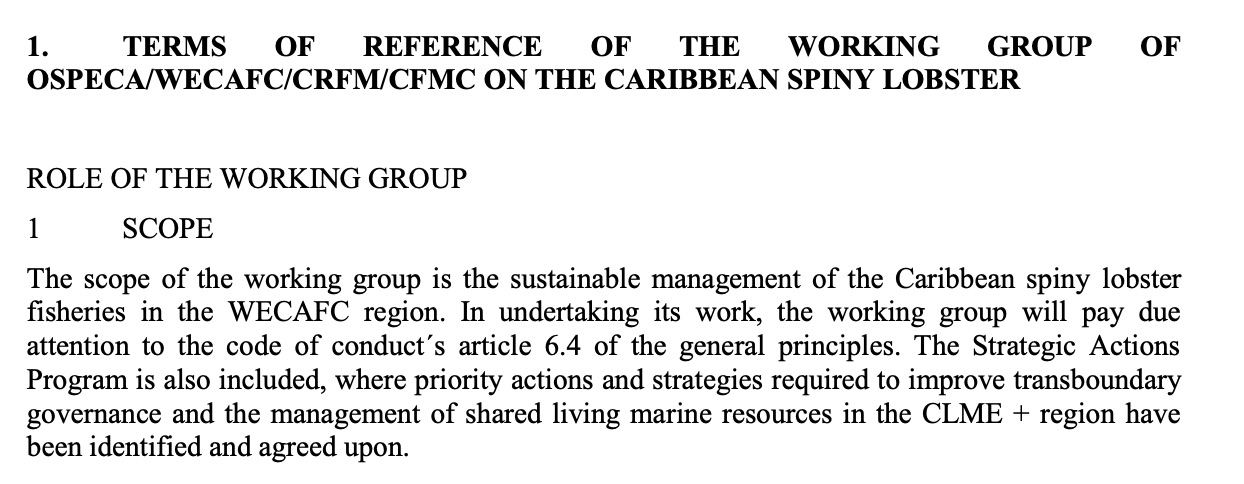
ToR WORKING GROUP ON CARIBBEAN SPINY LOBSTER (2019)
To date no abstract has been uploaded for this document
2
Report issue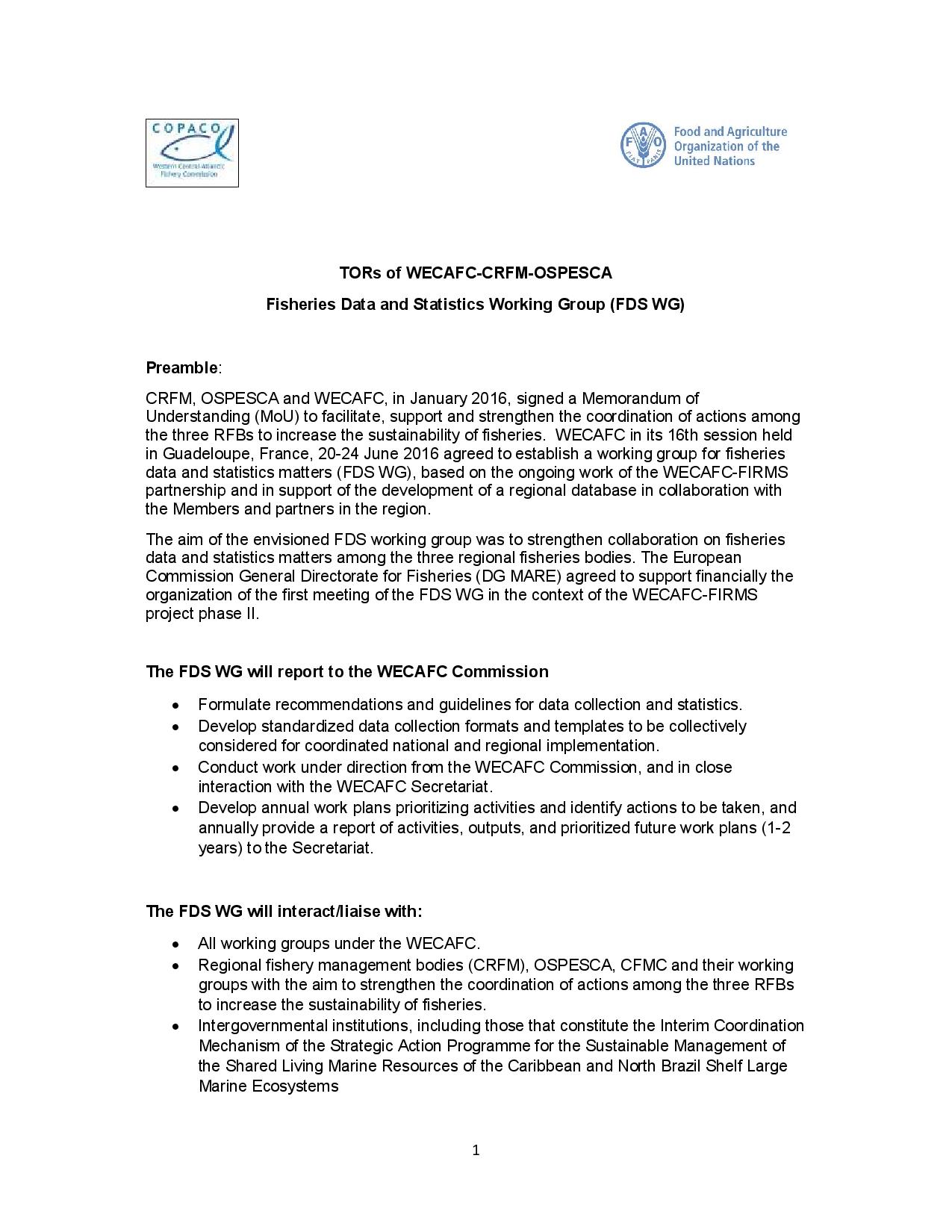
TORs of WECAFC-CRFM-OSPESCA – Fisheries Data and Statistics Working Group (FDS WG) 2019
CRFM, OSPESCA and WECAFC, in January 2016, signed a Memorandum of Understanding (MoU) to facilitate, support and strengthen the coordination of actions among the three RFBs to increase the sustainability of fisheries. WECAFC in its 16th session held in Guadeloupe, France, 20-24 June 2016 agreed to establish a working group for fisheries data and statistics matters (FDS WG), based on the ongoing work of the WECAFC-FIRMS partnership and in support of the development of a regional database in collaboration with the Members and partners in the region. The aim of the envisioned FDS working group was to strengthen collaboration on fisheries data and statistics matters among the three regional fisheries bodies. The European Commission General Directorate for Fisheries (DG MARE) agreed to support financially the organization of the first meeting of the FDS WG in the context of the WECAFC-FIRMS project phase II.
1
Report issue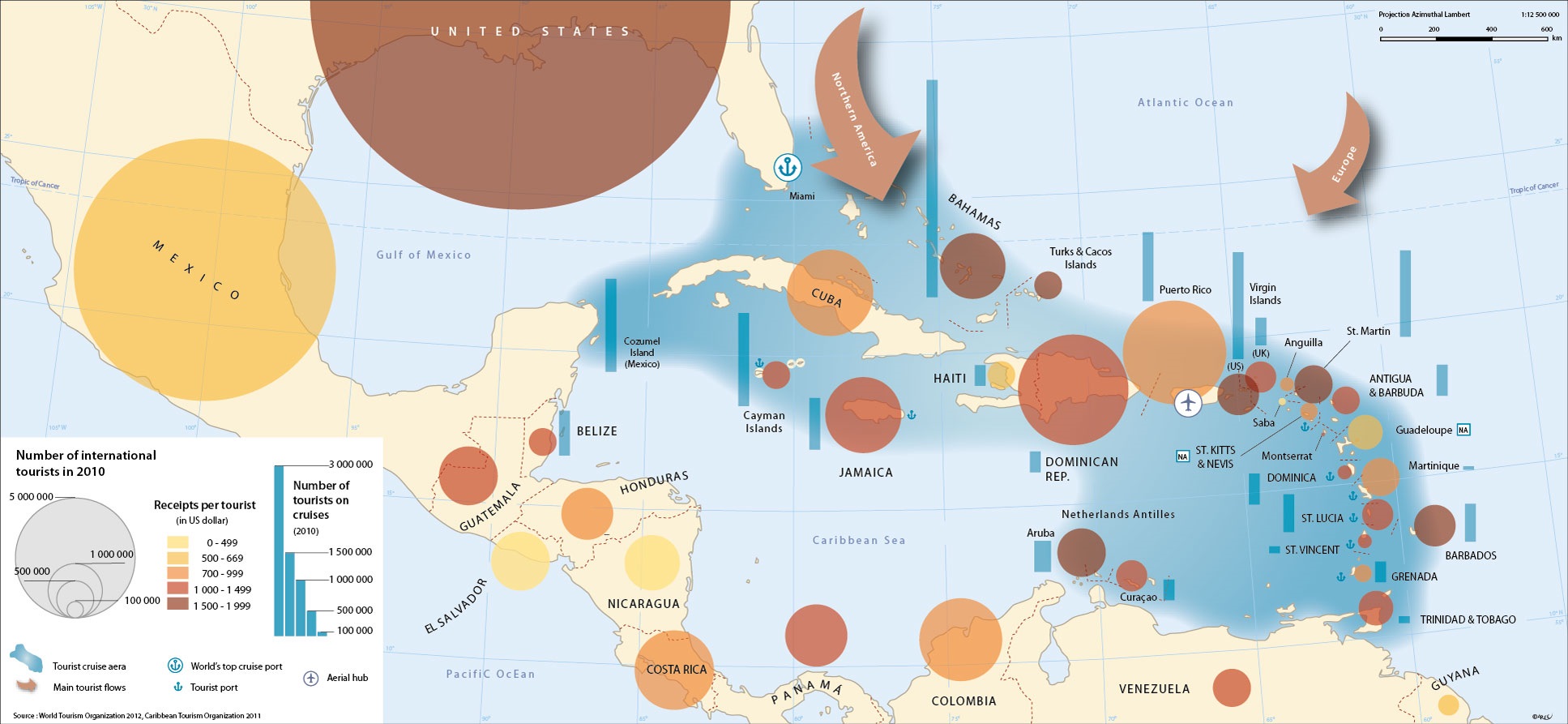
Tourism in the Caribbean Region (2010-2011)
Tourism is the Caribbean's newest industry, particularly across the islands of the Archipelago. It has developed uninterrupted over the past thirty years, and since the 1990s has brought periods of continuous growth to many small island communities. Along the mainland coast, wherever tourism has been developed, the numbers involved have proved much greater than on the islands. Nevertheless, for several Caribbean islands, tourism represents the most important economic activity. This map contains an illustrative explanation on how tourism behavior in the Caribbean.
2
Report issue
Toward a Blue Economy: A Promise for Sustainable Growth in the Caribbean
This report attempts to quantify the current ocean economy in the region and summarize projections about where we may find new pockets of sustainable growth, and define the blue economy concepts and possible policy responses that might better align economic growth and environmental health in the Caribbean.
3
1
Report issue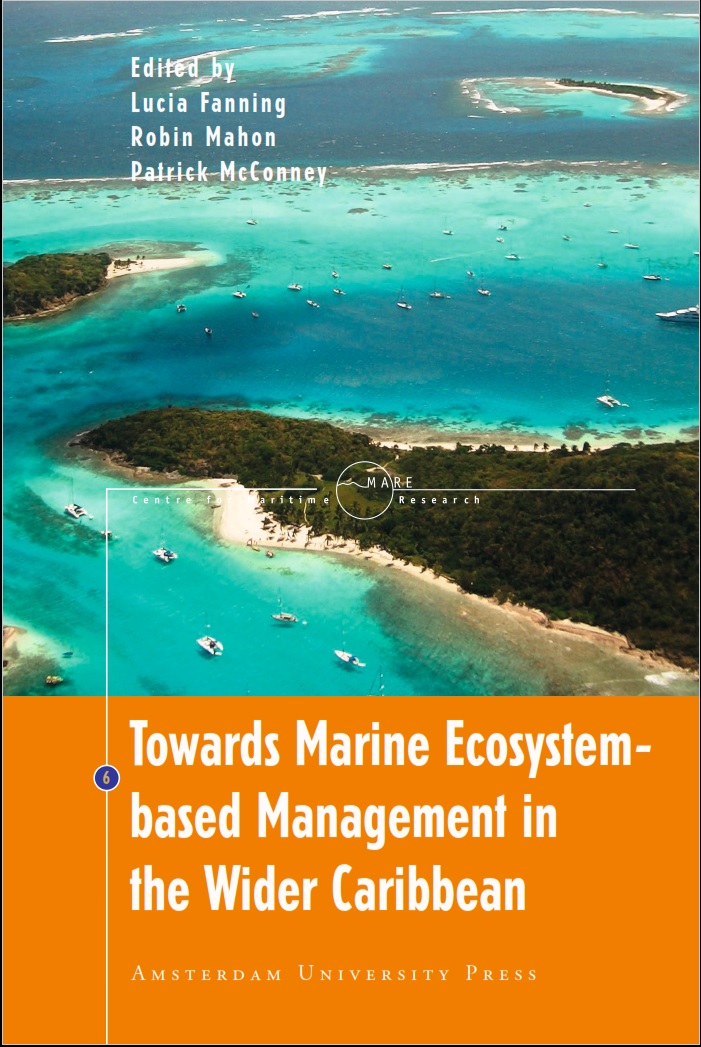
Towards Marine Ecosystem-based Management in the Wider Caribbean
Abstract: In order to ensure sustainable use of their shared marine resources, the nations of the West Caribbean Region must adopt an approach that encompasses both the human and natural dimensions of ecosystems. This volume directly contributes to that vision, bringing together the collective knowledge and experience of scholars and practitioners within the wider Caribbean to assemble a road map towards marine ecosystem based management for the region. The research presented here will be used not only as a training tool for graduate students, but also as comparative example and guide for stakeholders and policy makers in each of the world’s sixty-four large marine ecosystems.
3
1
Report issueTowards the establishment of the Permanent Coordination Mechanism: process & timeline
PSC2006_AI5.3-Process-and-Tentative-Timeline.
Report issue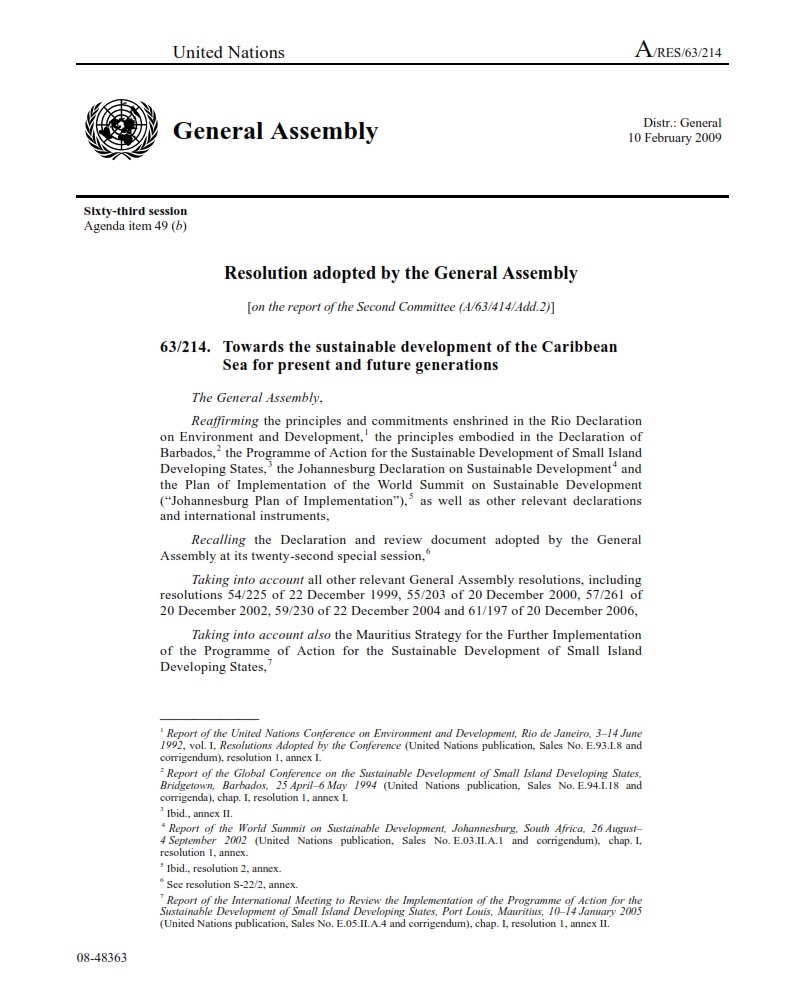
Towards the sustainable development of the Caribbean Sea for present and future generations: resolution / adopted by the UN General Assembly 63/214
In this resolution the General Assembly called on the United Nations system and the international community to assist, as appropriate, Caribbean countries and their regional organizations in their efforts to ensure the protection and sustainable management of the Caribbean Sea, and requested the Secretary-General to report to it at its sixty-fifth session on the status of the implementation of the said resolution, and to include “a section on the possible legal and financial implications of the concept of the Caribbean Sea as a special area within the context of sustainable development, including its designation as such without prejudice to relevant international law, taking into account the views expressed by Member States and relevant regional organizations.”
Report issue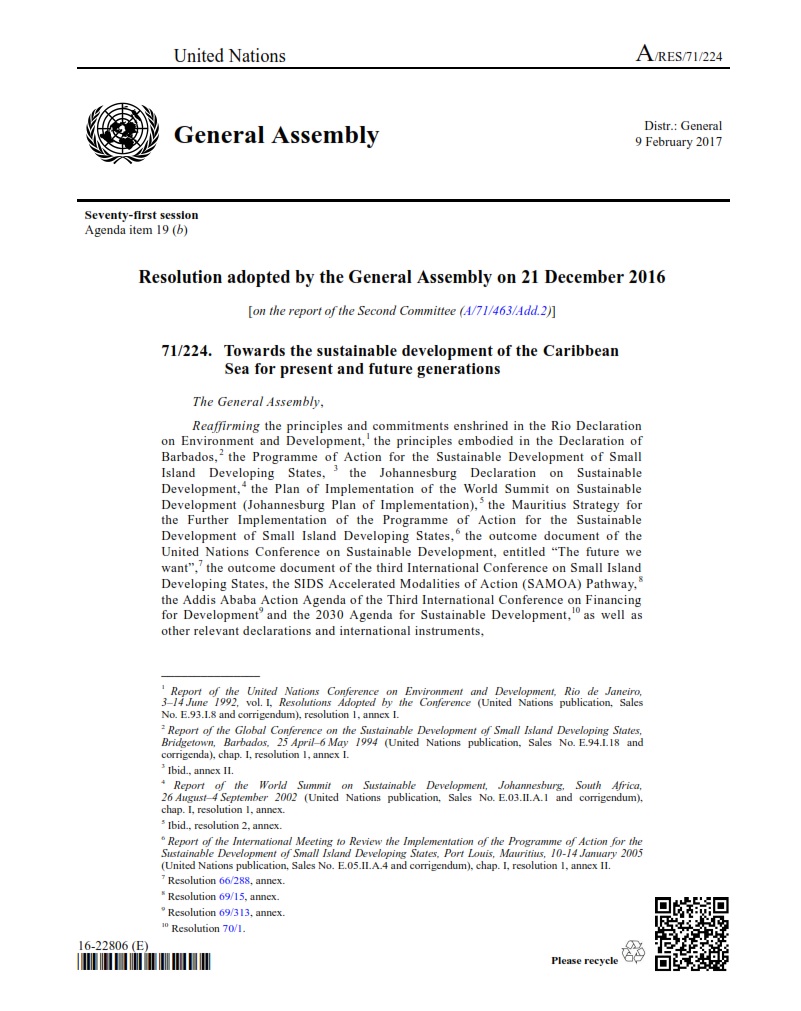
Towards the sustainable development of the Caribbean Sea for present and future generations: resolution / adopted by the UN General Assembly 71/224
In this resolution the General Assembly recognized that the Caribbean Sea was an area with unique biodiversity and highly fragile ecosystems and that, when compared with all other marine ecosystems, was surrounded by the largest number of countries in the world, many of which rely heavily on the marine environment for economic growth and sustainable development. The Assembly welcomed the continued efforts of Caribbean States to develop and implement regional initiatives to promote the sustainable conservation and management of coastal and marine resources and recalled the creation of the Caribbean Sea Commission of the Association of Caribbean States. In that regard, the Assembly invited the international community and the United Nations system to enhance their support to Caribbean countries and their regional organizations in efforts to implement the plan of action adopted by the Commission. The General Assembly also invited the Association to submit a report to the Secretary-General on progress made in implementation of the resolution, for consideration by the Assembly at its seventy-third session.
Report issue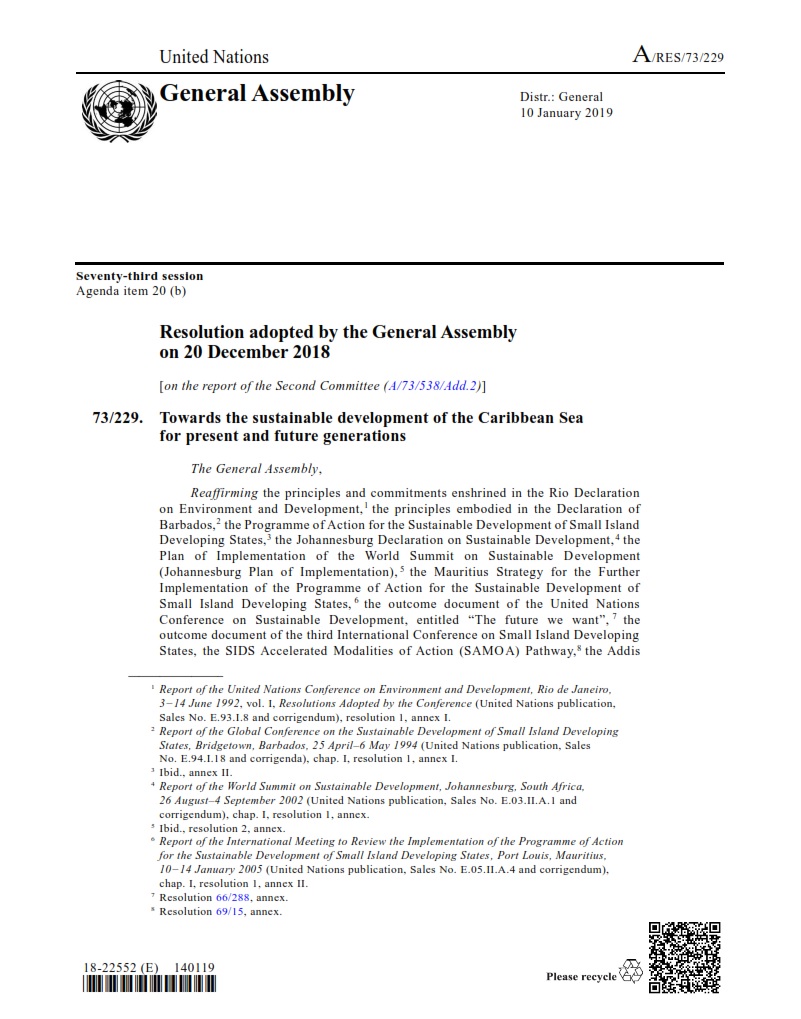
Towards the sustainable development of the Caribbean Sea for present and future generations: resolution / adopted by the UN General Assembly 73/229
In this resolution the General Assembly recognized that the Caribbean Sea was an area with unique biodiversity and highly fragile ecosystems and that, when compared with all other marine ecosystems, was surrounded by the largest number of countries in the world, many of which rely heavily on the marine environment for economic growth and sustainable development. In this 2018 resolution the Assembly underlines the need to address the economic, social and environmental impacts of climate change, and emphasizes the need for regional and international action to enhance efforts at the national and subnational levels, as appropriate, to build resilience. In that regard, the Assembly invited the international community and the United Nations system to enhance their support to Caribbean countries and their regional organizations in efforts to implement the plan of action adopted by the Commission. The General Assembly also invited the Association to submit a report to the Secretary-General on progress made in implementation of the resolution, for consideration by the Assembly at its seventy-fifth session.
Report issue