
Displaying 711-720 of 735 results

Wastewater: From Waste to Resource – The Case of New Cairo, Egypt
The Arab Republic of Egypt is a water-scarce country. Most of the country is desert, with the exception of the corridor of urban development along the Nile River and the Mediterranean Sea. Population growth in Egypt’s main urban areas prompted the Government of Egypt (GoE) to encourage the growth of new urban centers to alleviate overcrowding and pressure. Out of necessity, these new centers were located further away from the Nile River. The harsh environmental conditions of the location, combined with the low level of infrastructure present in these areas, have created a potential barrier to the successful establishment of the new cities. One avenue to address these concerns is the rationalization of water use in the new cities, such as by recycling wastewater for use as irrigation for agriculture.


 Report issue
Wastewater: From Waste to Resource – The Case of PRODES, Brazil
Water supply and sanitation is the responsibility of municipalities in Brazil. Some municipalities provide services through public operation, while others outsource to private operation. Many of the municipalities receive funding for these projects from the central government through loans from national or international institutions. Before 2001, the central government provided funding for sanitation projects through input subsidies to both private and public entities. These input subsidies aimed to pay for part of the costs of establishing and maintaining wastewater treatment plants (WWTPs).
Report issue
Wastewater: From Waste to Resource – The Case of Ridgewood, NJ, USA
Ridgewood, in New Jersey (NJ), upgraded its wastewater treatment plant (WWTP) in 2005 by installing two anaerobic digesters to comply with stricter federal and state environmental standards. However, the biogas produced in the process was being burned and released to the environment. The municipality saw an opportunity to use the wasted methane and convert it into energy for the WWTP. Through a successful public-private partnership (PPP), the Ridgewood WWTP achieved energy neutrality and became a referent on sustainable municipal wastewater treatment in the region.
Report issue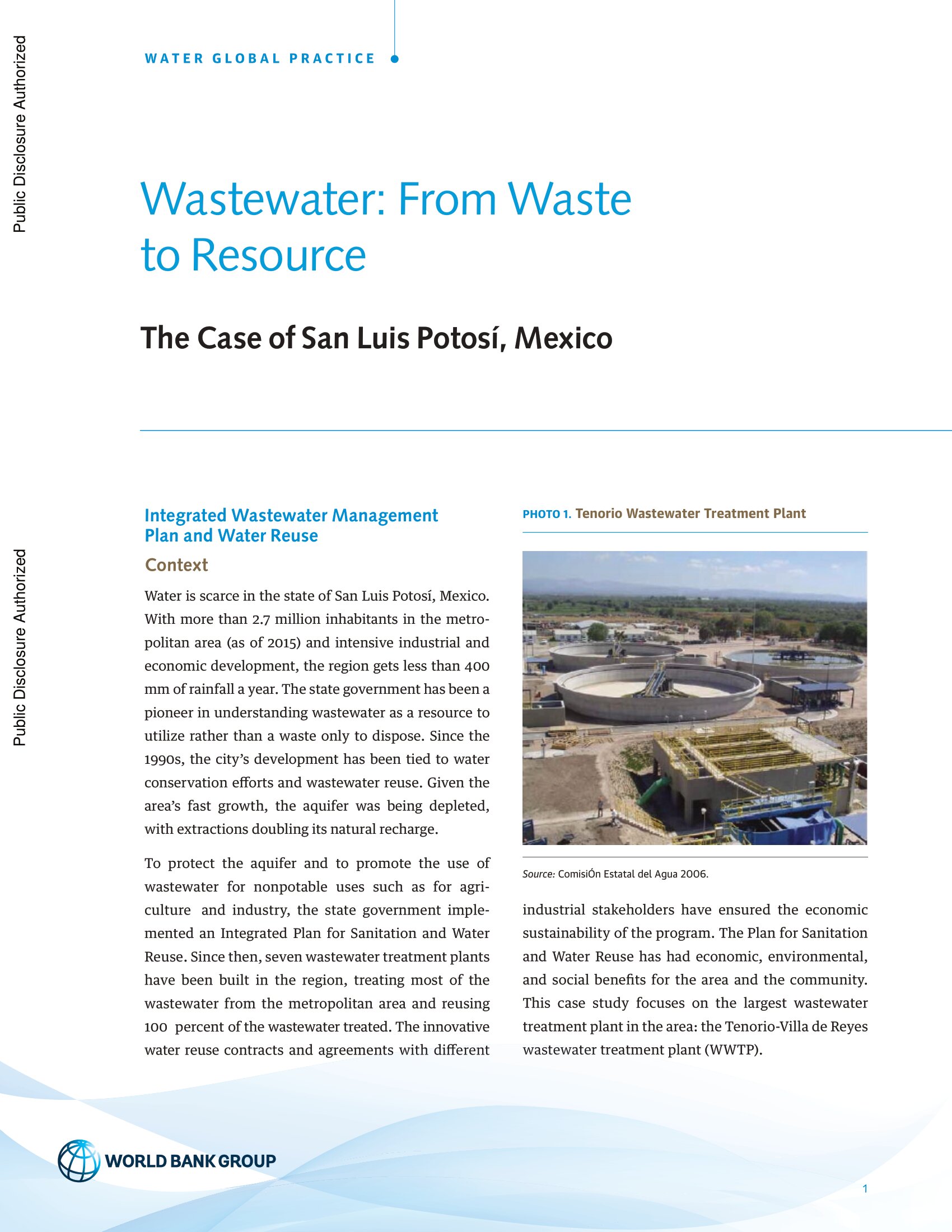
Wastewater: From Waste to Resource – The Case of San Luis Potosí, Mexico
Water is scarce in the state of San Luis Potosí, Mexico. With more than 2.7 million inhabitants in the metropolitan area (as of 2015) and intensive industrial and economic development, the region gets less than 400 mm of rainfall a year. The state government has been a pioneer in understanding wastewater as a resource to utilize rather than a waste only to dispose. Since the 1990s, the city’s development has been tied to water conservation efforts and wastewater reuse. Given the area’s fast growth, the aquifer was being depleted, with extractions doubling its natural recharge.
Report issue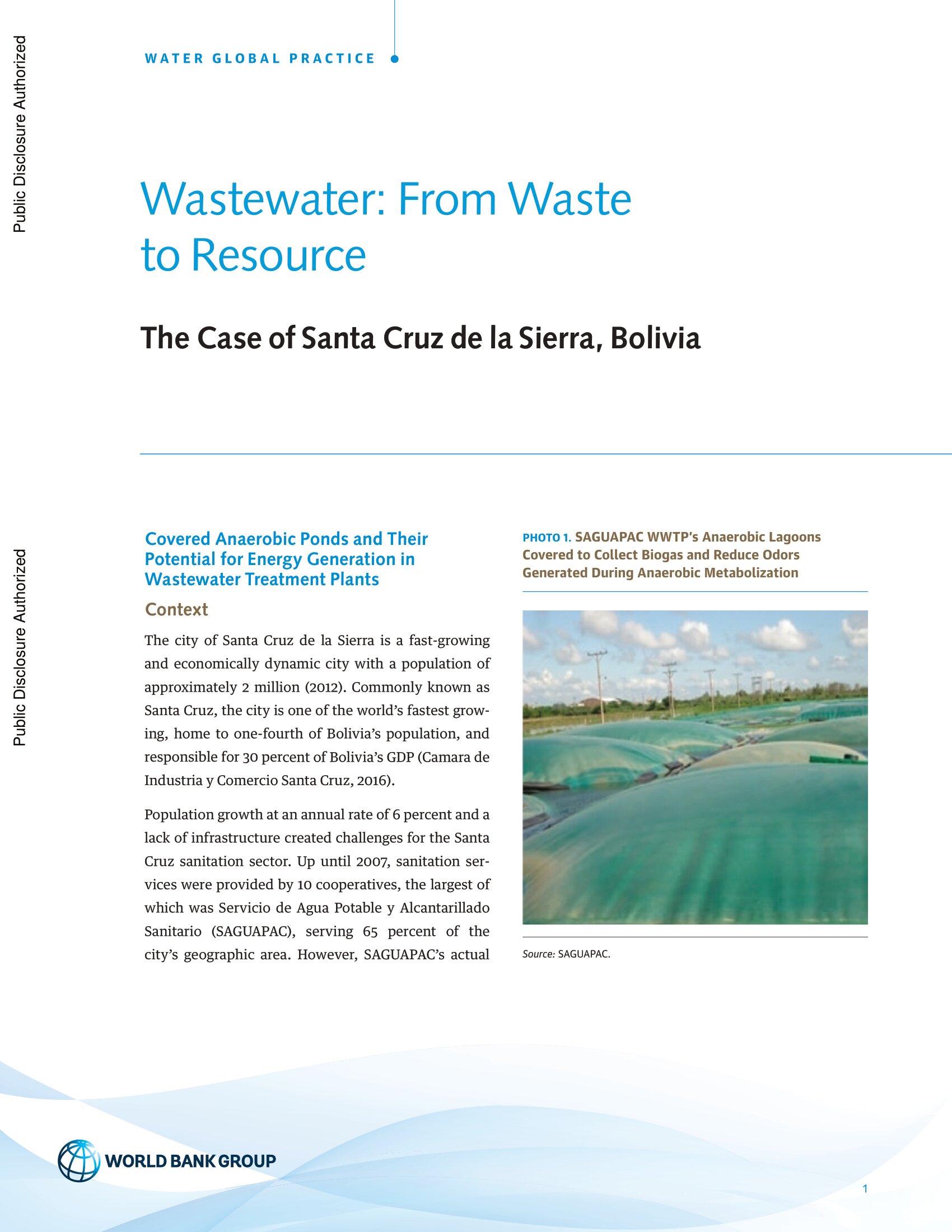
Wastewater: From Waste to Resource – The Case of Santa Cruz de la Sierra, Bolivia
This Documents explain the Covered Anaerobic Ponds and Their Potential for Energy Generation in Wastewater Treatment Plants in The city of Santa Cruz de la Sierra, that is a fast-growing and economically dynamic city with a population of approximately 2 million (2012) home to one-fourth of Bolivia’s population, and responsible for 30 percent of Bolivia’s GDP (Camara de Industria y Comercio Santa Cruz, 2016).
Report issue
Wastewater: The Untapped Resource – The United Nations World Water Development Report 2017 (Presentation)
To date no abstract has been uploaded for this document
1
Report issue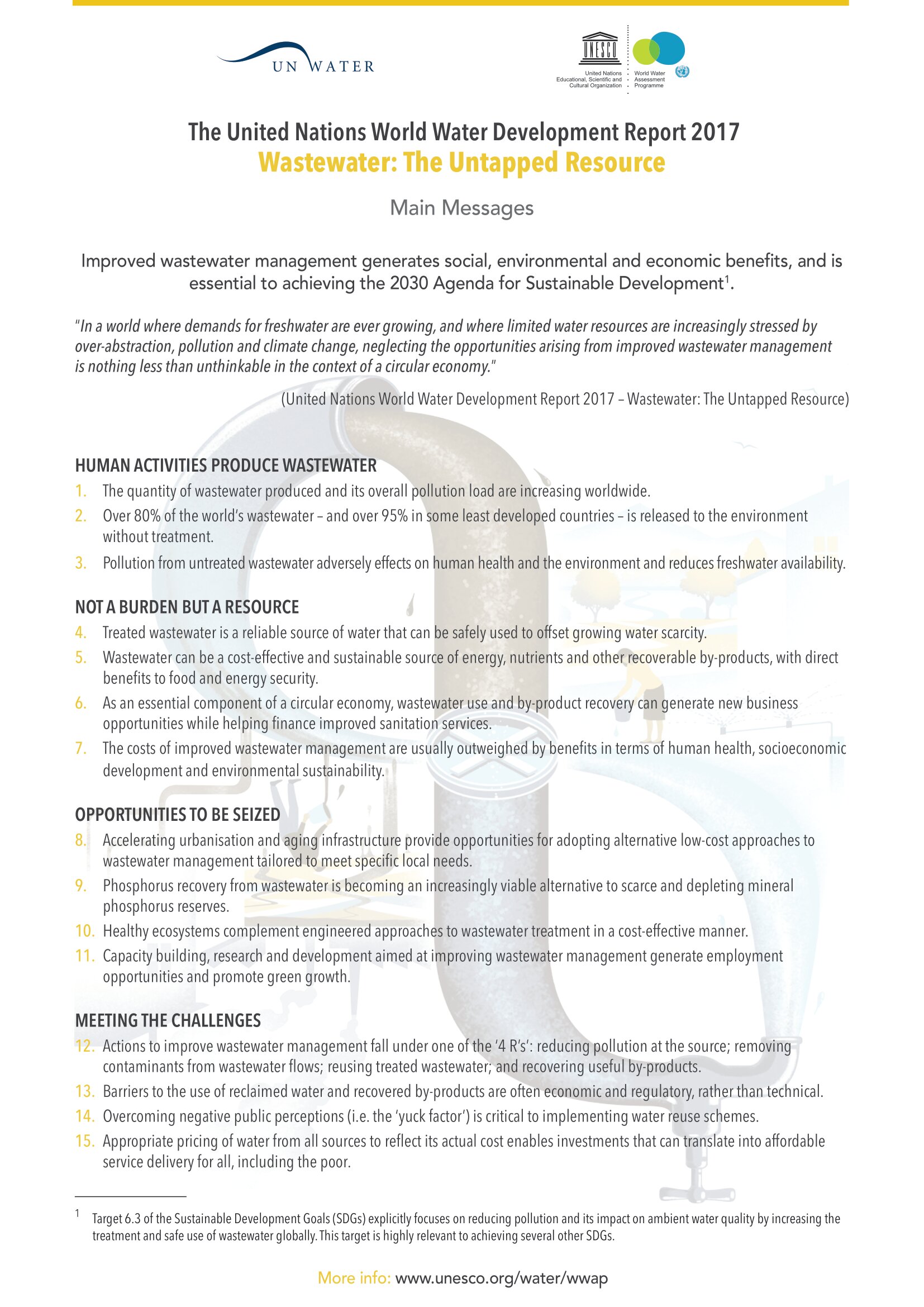
Wastewater: The Untapped Resource Main Messages – The United Nations World Water Development Report 2017
This Documents Provides a condensed information of the The United Nations World Water Development Report 2017.
Report issue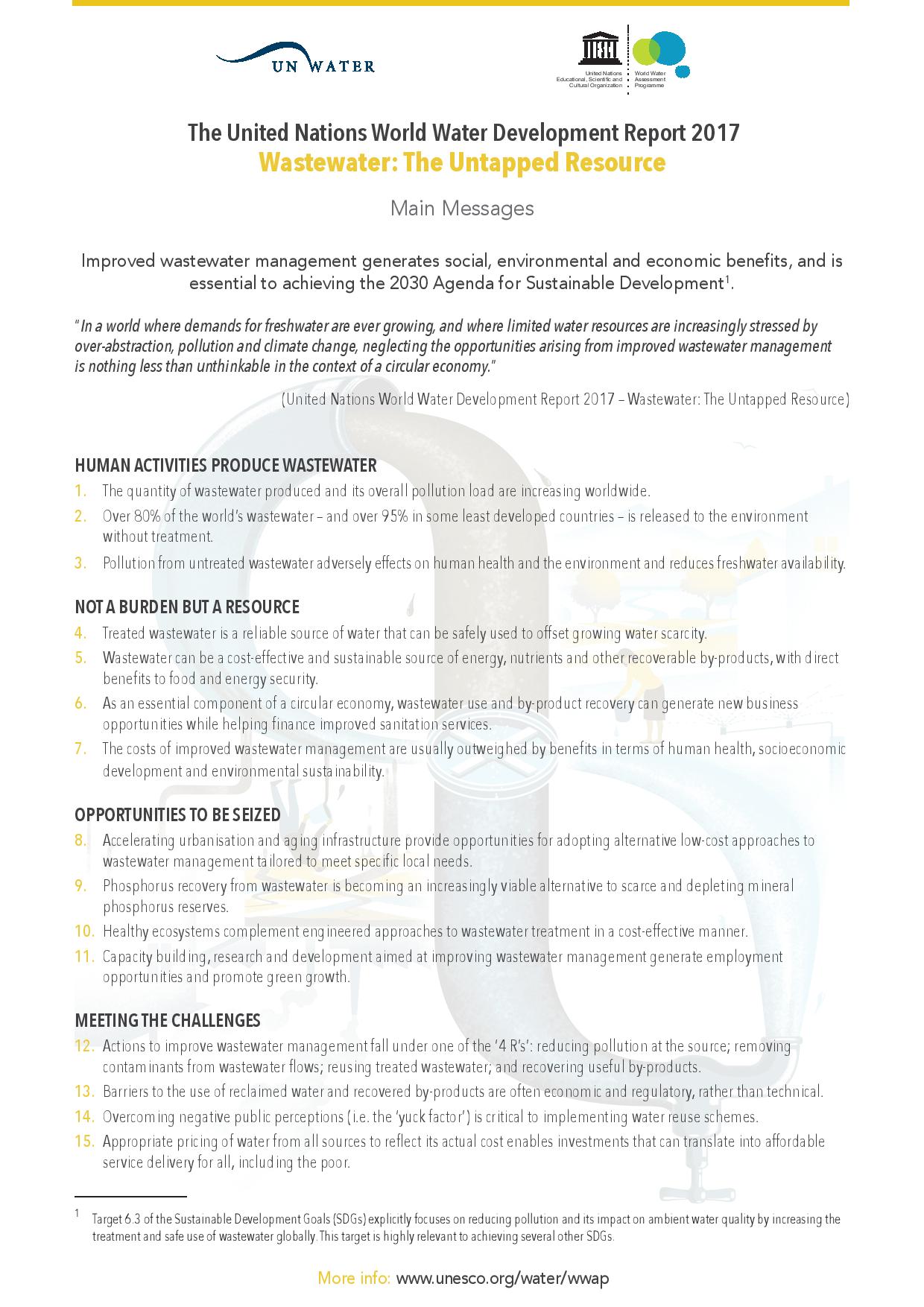
Wastewater: The Untapped Resource Main Messages – The United Nations World Water Development Report 2017
This document summarizes brief messages from The United Nations World Water Development Report 2017 Wastewater: The Untapped Resource, highlighting the themes in the following topis:
- Human Activities produce wastewater
- Not a burden but a resource
- Opportunities to be seized
- Meeting the Challenges
Report issue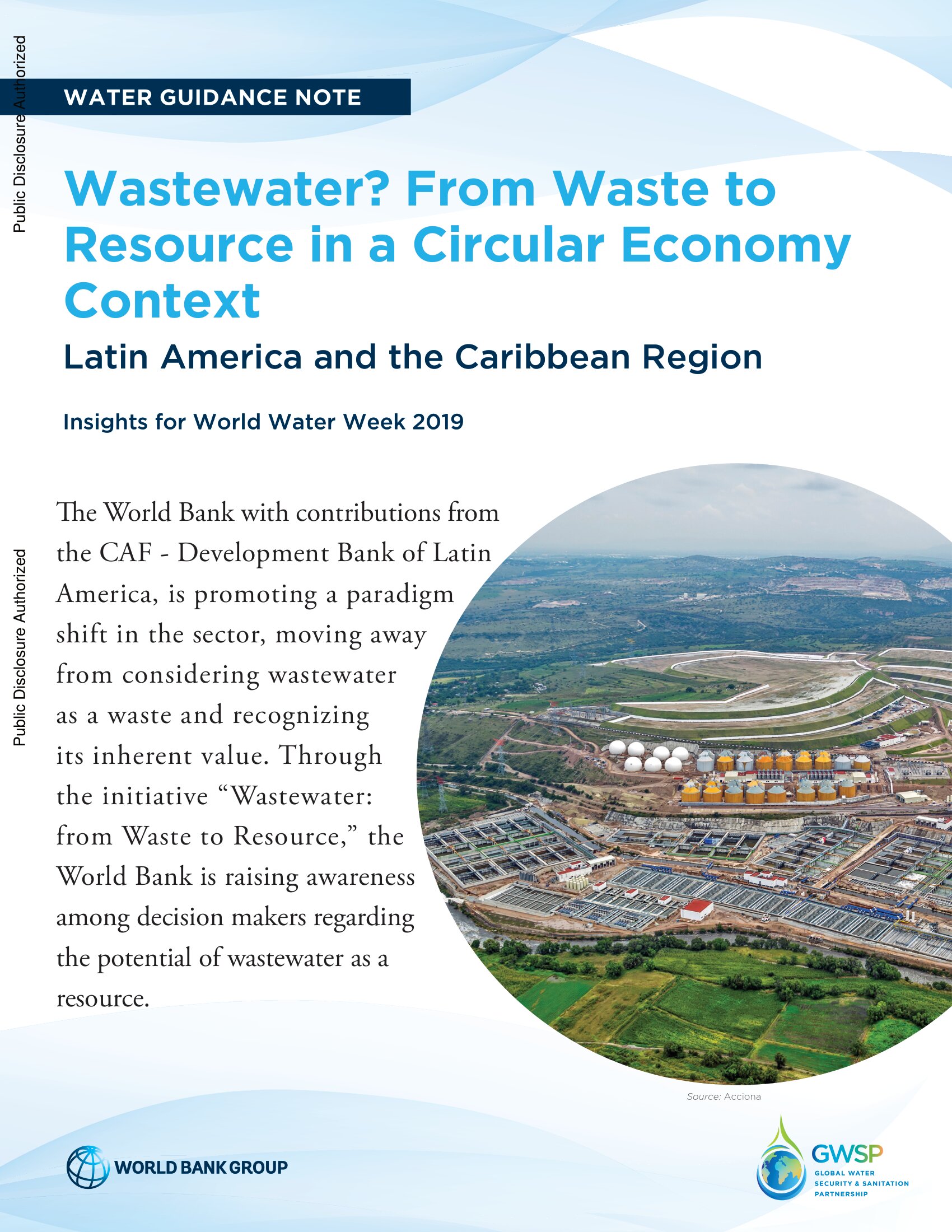
Wastewater? From Waste to Resource in a Circular Economy Context Latin America and the Caribbean Region
The World Bank with contributions from the CAF - Development Bank of Latin America, is promoting a paradigm shift in the sector, moving away from considering wastewater as a waste and recognizing its inherent value. Through the initiative “Wastewater: from Waste to Resource,” the World Bank is raising awareness among decision makers regarding the potential of wastewater as a resource.
1
Report issue
WECAFC – Workshop on Management of the Caribbean Spiny Lobster (Panulirus argus) Fisheries in the Area of the Western Central Atlantic Fishery Commission. Merida, Mexico
To date no abstract has been uploaded for this document
Report issue